Roof leak detection in San Diego is critical for protecting your home's structural integrity and preventing costly water damage. Finding the source of a roof leak quickly can save you thousands of dollars and preserve your property value.
Quick Guide to Locating Hidden Roof Leaks:
San Diego's unique climate creates hidden challenges for homeowners. As one local roofing company observed, "It doesn't rain much in San Diego, so homeowners often don't realize they have a leaking roof. That's why when it does rain, our phone rings off the hook!"
The problem? Water doesn't always appear where it enters. A leak in your roof can travel several feet along rafters or sheathing before showing up as a stain on your ceiling. By the time you notice damage inside your home, the leak may have already compromised insulation, framing, or drywall.
San Diego's infrequent rain delays detection until heavy storms hit. Meanwhile, intense UV exposure and thermal expansion gradually degrade roofing materials. Older homes with lath and stucco walls can hide water up to five times longer than modern drywall construction—turning small leaks into major repair projects.
Early detection matters. Ignoring a roof leak leads to wood rot, mold growth that threatens your family's health, and structural damage that can cost thousands more than a simple repair. The research shows that plumbing leaks alone can cause hundreds of dollars in damage per day—and roof leaks are just as destructive.

Being a "home detective" starts with knowing what to look for. In places like Mira Mesa or Chula Vista, where the sun beats down for months before a sudden winter storm, your roof undergoes a lot of stress. Here are the most common signs that you need professional roof leak detection in San Diego.
The most obvious sign is a water stain on your ceiling or walls. These often look like brownish "puddles" with rings. However, don't just look up; look at your paint. Peeling, bubbling, or blistering paint near the ceiling line often indicates that moisture is trapped behind the surface.
If you suspect a leak, one of the first things we recommend is moisture mapping. This process helps us visualize where the water is concentrating, even if it hasn't broken through the drywall yet.
Your attic is the "crime scene" where the most evidence is found. Check for:
Mold development is a major red flag. In San Diego’s humid coastal areas like Del Mar or Encinitas, a small leak can quickly turn into a fuzzy, black, or green health hazard. If you smell a musty odor but can't find the source, the leak might be hidden in the walls.
On the outside, keep an eye on your shingles or tiles. Are there bare spots where the granules have worn off? Do you see curling shingle tabs or cracked tiles? Granule accumulation in your gutters is like "roof dandruff"—it means your roof is aging and becoming more porous.
Before you start tearing into your roof, you need to make sure the "culprit" isn't actually your plumbing. It’s a common mix-up! Here is how we distinguish between the two:
| Characteristic | Roof Leak | Plumbing Leak |
|---|---|---|
| Timing | Happens during or after rain | Constant, regardless of weather |
| Water Color | Dirty, brownish, or tea-colored | Usually clear (unless it's sewage) |
| Location | Often near chimneys, vents, or valleys | Near bathrooms, kitchens, or under slabs |
| Flow Rate | Varies with rain intensity | Often a steady drip or spray |
One of the easiest DIY detective tricks is using your water meter. Turn off every faucet, shower, and appliance in your home. Go out to your water meter box (usually near the sidewalk). If the dial is still moving, you have a plumbing leak. If it stays perfectly still, but you still have water stains after a storm, you are looking at a roof issue.
Water is lazy; it takes the path of least resistance. We often find skylight leakage because the seals have dried out in the San Diego sun. Another common offender is the roof penetration leak, which occurs around vents, pipes, or anything that pokes through your roof.
San Diego homes often use lath and stucco. As mentioned earlier, stucco can hold water five times longer than drywall. This means a leak might happen on Monday during a storm, but you won't see the dampness on your interior wall until Friday.
To ensure we are being as accurate as possible, we follow scientific guidelines for evaluating water leakage, specifically the ASTM E2128 standard. This isn't just "spraying a hose at the roof." It's a systematic approach to replicating the exact conditions that cause the intrusion.
Gone are the days of just "guessing" where a leak starts. Today, we use "ninja-level" technology to find moisture without poking holes in your beautiful home.
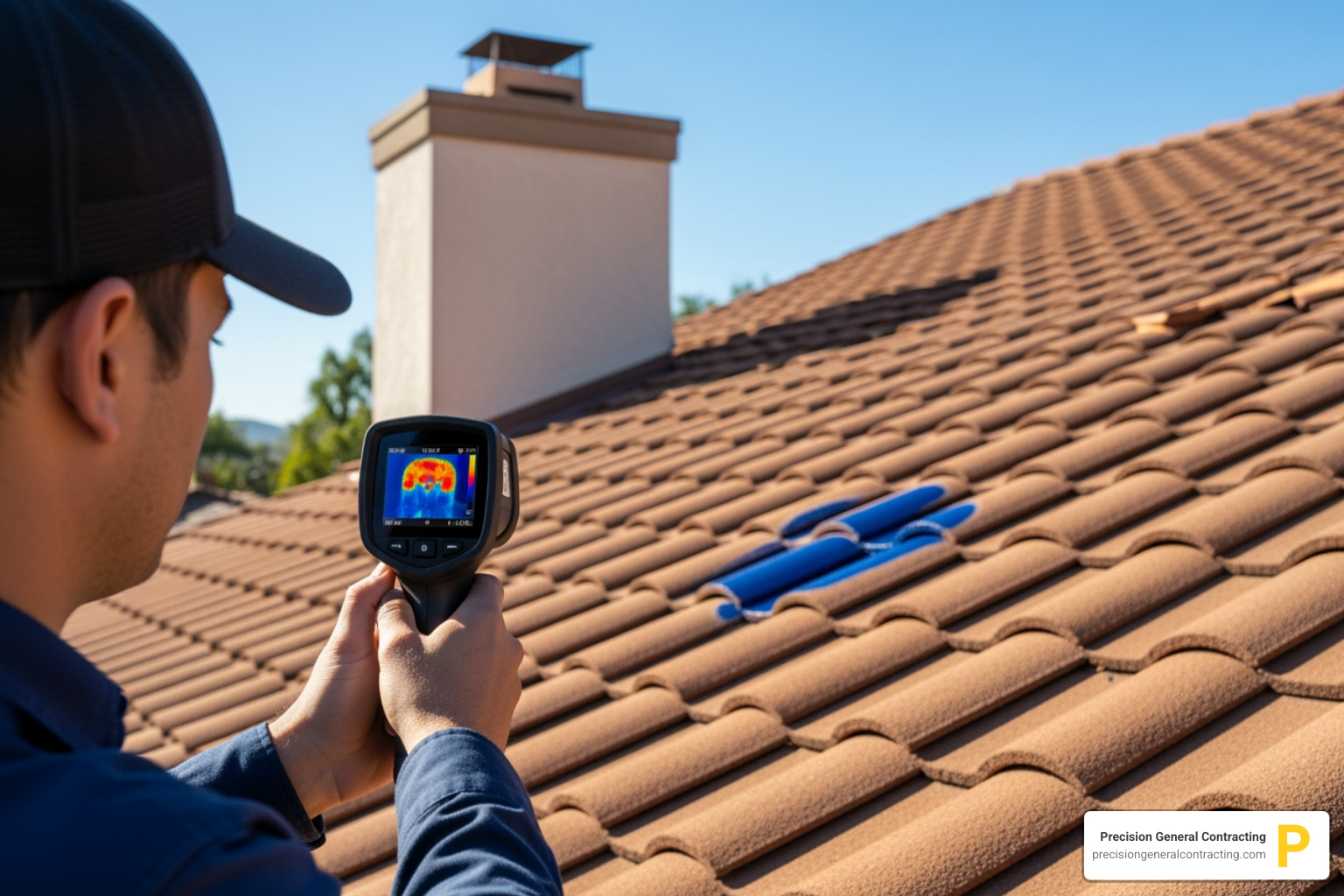
Infrared moisture scanning is a game-changer. Using a thermal camera, we can see temperature differences in your walls and ceilings. Since wet materials are usually cooler than dry ones, the leak shows up as a dark purple or blue "bloom" on our screen. It allows us to see the invisible!
Moisture meter allows us to touch a surface and get a digital reading of how much water is inside. For those hard-to-reach spots on a three-story home in La Jolla, a roof drone inspection provides high-definition views of every tile and shingle without us having to risk a ladder climb.
We use sequential isolation testing. This means we test one small area at a time—starting from the bottom and working our way up—to pinpoint the exact entry point. This forensic approach is why we recommend you get professional roof leak identification in San Diego from specialists who have the right tools.
Once the "detective work" is done and we've found the source, it's time for the "surgical" phase. Here is how the process typically goes:
We document everything. If you plan on filing an insurance claim, you’ll need photos of the damage and the source. Most San Diego homeowners find that insurance covers the result of the leak (like your ruined ceiling) but not always the cause (the old roof). However, having a pro document the "storm damage" can be the difference between a denied claim and a check in the mail.
If a storm is still raging, we might perform an emergency roof repair. This usually involves emergency tarping to stop the bleeding until the sun comes out and we can do a permanent fix.
Depending on what we found, the repair might include:
After the roof is watertight, you still have the interior to deal with. This might involve drywall repair, painting, or even mold remediation if the leak was ignored for too long.
The cost can vary wildly depending on the complexity of your home. A simple visual inspection might be free or low-cost, but advanced roof leak detection in San Diego using infrared and forensic testing typically ranges from $250 to $3,000+.
Why the range? Finding a leak on a flat roof in a Mira Mesa warehouse is very different from finding a "mystery drip" in a 5,000-square-foot custom home in Fairbanks Ranch with multiple roof levels and hidden valleys. Spending $500 on detection can save you $10,000 in structural repairs later!
San Diego is a "stealth" environment for leaks.
You should call a professional if:
At Precision General Contracting, we know that your home is your biggest investment. Whether you are in Poway, Escondido, or down in Coronado, a leaking roof is a stress you don't need. While we are experts at finding and fixing these issues, we also believe in prevention.
One of the best ways to protect your home is through an annual roof inspection. Catching a slipped tile or a cracked vent seal in July is much easier (and cheaper) than dealing with a flooded living room in December. The benefits of regular roof inspections cannot be overstated—it’s the difference between a minor maintenance task and a total roof replacement.
If you are looking for long-term solutions, we provide durable, low-maintenance covers made from premium structural aluminum. Our USP is a transferable Lifetime Warranty, ensuring your investment is resistant to rust, warping, cracking, rotting, and even those pesky San Diego termites.
Don't wait for the next storm to turn your home into a swimming pool. If you suspect a problem, reach out for expert roofing services in San Diego. We serve all of San Diego County, from the coast of Carlsbad to the hills of Rancho Santa Fe. Let us play detective so you can get back to enjoying the sunshine!