Fire-resistant siding for house protection isn't just about aesthetics—it's about keeping your family and investment safe. With wildfires burning nearly double the tree cover compared to two decades ago and 80 million properties facing significant wildfire exposure, choosing the right exterior materials has never been more critical.
According to a National Fire Protection Association study, fires cause about $7.3 billion in direct property damage each year, along with thousands of injuries and deaths. One in six Americans now live in a high-risk wildfire area.
Top Fire-Resistant Siding Materials:
James Hardie Fiber Cement siding - Class A fire rating, won't ignite or fuel flames, mimics wood aesthetics
Materials to Avoid:
Fire can engulf a home in just minutes. The difference between a structure that survives and one that doesn't often comes down to exterior materials. Embers from wildfires can travel over a mile, landing on combustible siding and igniting your home before flames ever arrive. Even everyday household fires from cooking or electrical issues pose serious risks to homes with flammable exteriors.
The good news? James Hardie fire-resistant siding options offer both superior protection and attractive designs that don't compromise your home's curb appeal.
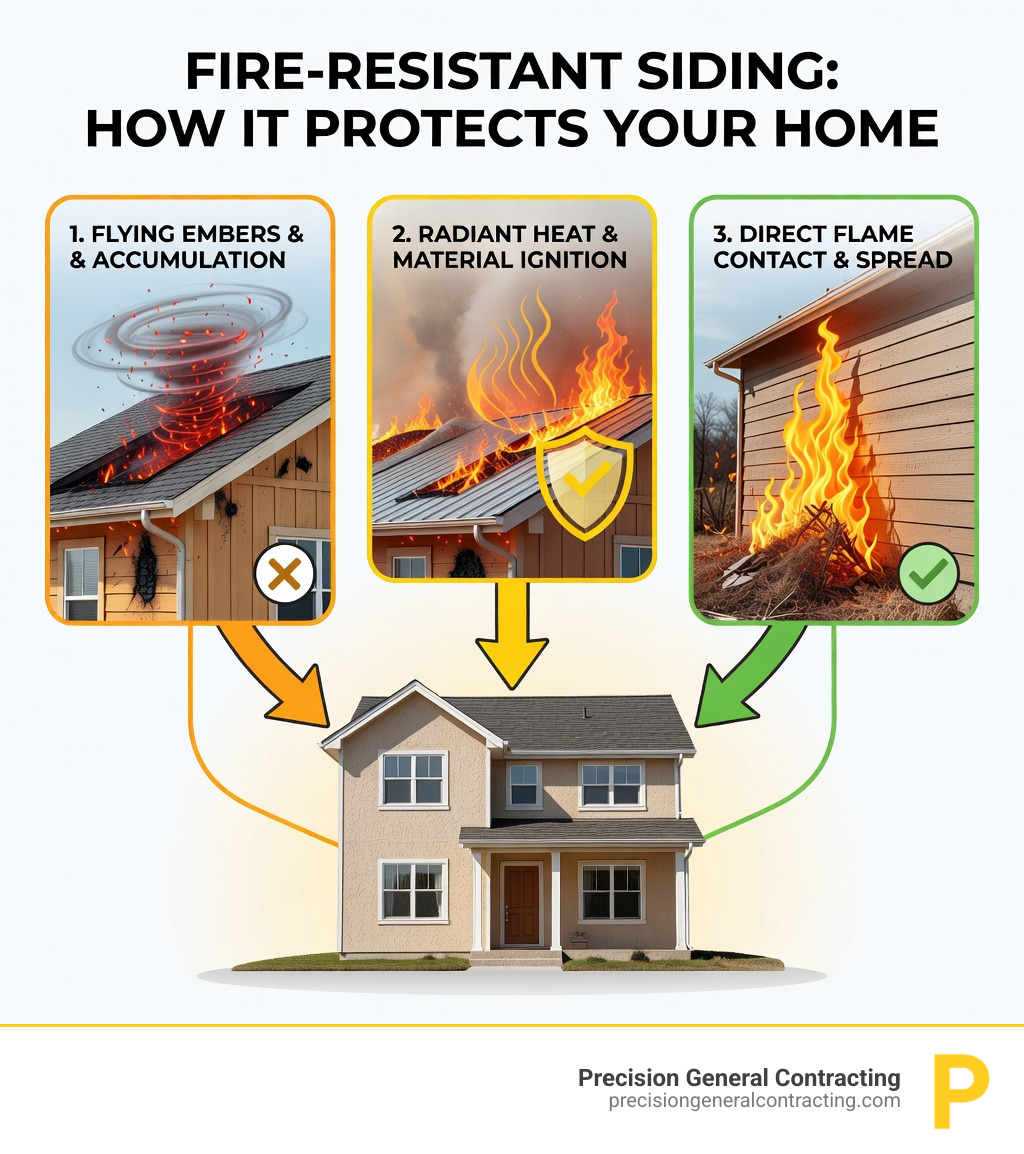
When we talk about protecting a home in San Diego, from the coastal breeze of Del Mar to the drier canyons of Scripps Ranch, we often hear the term "fireproof." However, in construction and safety, "fireproof" is a bit of a misnomer. Almost anything can burn if the fire is hot enough and lasts long enough. Instead, we look for James Hardie fire-resistant siding for house projects that can withstand the heat long enough to save the structure.
To choose the right material, you need to understand how these products are tested. The industry standard is the ASTM E84 test, which measures the surface burning characteristics of building materials. This test results in a fire-resistance-rating that tells us how quickly a flame spreads across the surface.
The holy grail for homeowners in wildfire-prone areas is the class a fire rating. Here is how the classifications break down:
There is a subtle but important difference between these two terms. Non-combustible materials are those that simply will not ignite or burn when exposed to fire. Think of a brick or a piece of steel. Ignition-resistant materials might be combustible at their core but are treated or engineered to resist ignition for a specific period, often aiming for a 1-hour fire rating. This means the wall assembly can prevent flames and heat from passing through for at least sixty minutes—precious time for firefighters to arrive.
Choosing the right material involves balancing safety, cost, and style. In San Diego County, where we face unique climate challenges, we recommend materials that can handle both the intense sun and the threat of seasonal wildfires.
| Material | Fire Rating | Maintenance | Relative Cost | Best For |
|---|---|---|---|---|
| James Hardie Fiber Cement | Class A | Low | Moderate | Modern & Traditional Homes |
Knowing how to choose the best fire-resistant siding for your property means looking beyond just the sticker price. You have to consider the "home hardening" aspect—how well the material integrates into a non-combustible cladding system.
Fiber cement has become the go-to choice for homeowners in areas like Poway and Rancho Bernardo. But what is fiber cement siding exactly? It is a mix of wood pulp (cellulose fibers), cement, sand, and water. This combination creates a material that is incredibly durable and, most importantly, non-combustible.
Is it the right choice for you? Many experts agree that fiber cement siding is the best choice for fire safety in San Diego. It doesn't just protect against fire; it also resists rotting, warping, and those pesky termites that cause over $2 billion in damage annually—more than fires and windstorms combined!
The best part for those who love the look of natural materials is that you can get fiber cement siding that nails the wood aesthetic. You get the beauty of cedar shakes or lap siding without the "tinderbox" anxiety.
To understand why you need fire-resistant siding upgrades, we have to look at the failures of common materials like vinyl and wood.
Vinyl siding is popular because it's cheap, but it is a nightmare in a fire. According to research on vinyl siding and the environment, vinyl has a very low melting point. Even before flames reach the house, radiant heat can cause vinyl to sag and melt. This exposes the flammable wood sheathing and studs underneath, effectively opening the door for the fire to enter your home. Furthermore, when vinyl burns, it releases toxic gases that are hazardous to both residents and first responders.
Natural wood siding, while beautiful, is essentially fuel. Whether it's cedar shingles or redwood laps, wood allows for rapid vertical flame spread. Once the bottom of a wood wall ignites, the fire "climbs" the siding into the eaves and the attic. Even if the wood is treated with fire retardants, its effectiveness can diminish over time due to San Diego's weathering cycles.
When comparing fiber cement siding to vinyl siding, the difference is staggering. In fire demonstrations, vinyl can succumb to flames in minutes, while fiber cement remains intact, acting as a shield for the rest of the structure.
If you live in a Wildland-Urban Interface (WUI) zone—areas where residential pockets meet the natural canyons and brush of San Diego—choosing the right siding is just the first step. You need a comprehensive fire-resistant remodeling strategy.
The best siding in the world can't save a house if there's a pile of firewood leaning against it. We recommend maintaining at least 15cm (about 6 inches) of vertical non-combustible clearance between the ground and the start of your siding. This prevents embers from accumulating at the base of the wall and igniting the siding or the framing behind it.
FEMA recommendations for exterior walls emphasize that your home is a system. To truly harden your home, you should also consider:
Homeowners often ask if they can just "paint on" fire protection. While there are fire-retardant treatments (FRT), they aren't a magic wand. Pressure-impregnated FRT wood is much more effective than surface coatings, as the chemicals are forced deep into the wood fibers.
However, surface-applied intumescent paints often fail to provide long-term protection in exterior environments. The intense sun in places like Escondido or El Cajon can cause these coatings to degrade. According to research on fire-retardant treatments, these chemicals can also "leach" out over time due to rain, requiring frequent reapplication. For true peace of mind, starting with a non-combustible material is always the better route.
Absolutely. While the initial cost of fiber cement or steel may be higher than vinyl, you have to look at the long-term value.
It’s not just about the fire you hope never happens; it’s about the decades of durability you get every single day.
No siding is truly "maintenance-free," but fire-resistant options come close. For fiber cement, you'll want to check the pros and cons regarding moisture management. Ensuring that gaps are properly caulked and that debris (like dry leaves) doesn't pile up against the siding is key.
For metal siding, maintenance is usually as simple as a spray-down with a garden hose once a year to remove salt spray if you're near the coast in Oceanside or Carlsbad. Always inspect the seals around windows and doors to ensure embers can't find a way into the wall cavity.
At Precision General Contracting, we believe that a home should be a sanctuary, not a source of stress. Whether you are in the heart of San Diego, the hills of Fallbrook, or the coastal beauty of Solana Beach, investing in fire-resistant siding for your house's protection is one of the smartest moves you can make.
Our commitment to quality extends beyond just siding. We specialize in home hardening strategies that protect your investment from the ground up. We also offer durable, low-maintenance Four Seasons covers made from premium structural aluminum, backed by a transferable Lifetime Warranty. This ensures your outdoor spaces are just as resilient as your home's exterior—resisting rust, warping, cracking, and even those hungry San Diego insects.
Ready to upgrade your home’s defense? You can find more info about siding in San Diego on our website. Don't wait for the next fire season to wonder if your home can stand the heat. Let's build something beautiful, durable, and—most importantly—safe.